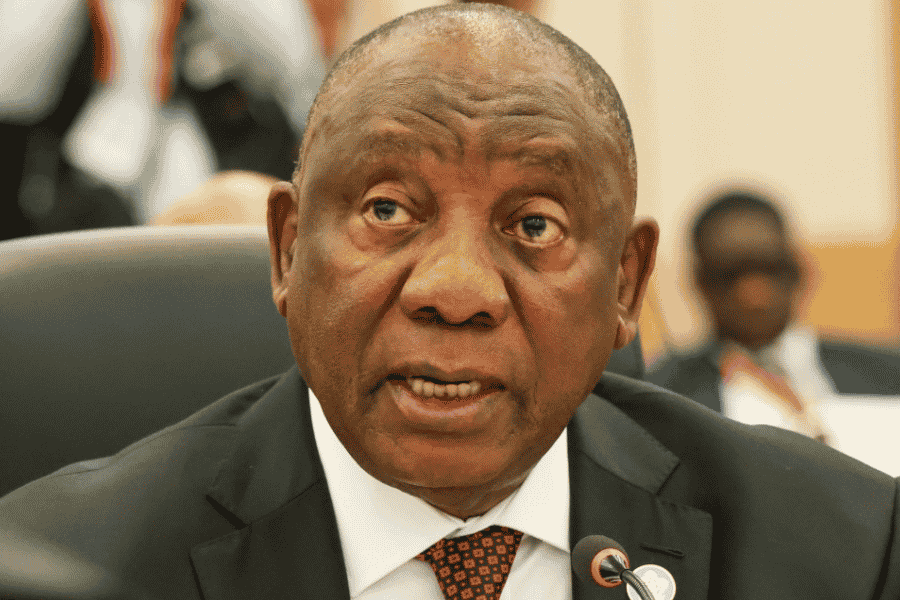
For the second time in seven years, President Cyril Ramaphosa stood before the nation on Tuesday night to declare GBVF a national disaster — but instead of relief, his address ignited fury from opposition parties, activists and NGOs who say his speeches are hollow while women are still being hunted and killed.
In November 2025, Ramaphosa officially declared GBVF a National Disaster. On Tuesday, faced with 11 women’s bodies discovered across Ekurhuleni since July, he returned with four immediate measures: a national recovery operation into unresolved GBVF cases involving women and children, women’s safety audits by municipalities, identification of hotspots, and tackling forensic backlogs.
He gave himself and his Cabinet 60 to 90 days to act, but for those confronting the bodies on the ground, the promises came too little, too late.
Veteran activist Dennis Bloem said victims and families were tired of speeches and preferred action.
“The country is in a crisis. The country does not have leadership. Twice has President Cyril Ramaphosa declared GBVF a disaster. What does this mean? Absolutely nothing,” Bloem said.
“Once again President Ramaphosa has disappointed. He is a man of big English without any meaning. Only empty promises.”
Bloem said the four-point plan offered nothing new.
“President has said nothing new. It is very disappointing that he is talking about high grass, dirty cemeteries, street lights and other things that are known to all of us. These are things that we see everyday. We expected to hear about immediate action that will be implemented tomorrow, but the President is telling us that he wants to see results in 90 days. The question is about tomorrow? Will women be safe?”
The Economic Freedom Fighters said Ramaphosa’s decision to address the nation only after immense public pressure exposed a government that responds to outrage rather than preventing violence.
“The women whose lives were taken in Ekurhuleni did not become victims when their bodies were discovered. They were failed long before their deaths by institutions that are supposed to protect them, and it is very insulting for the President to invoke their names while presenting the State as though it is only now confronting GBVF,” the EFF said.
The party rejected the idea that South Africa needs another audit to understand the crisis.
“South Africa does not suffer from an absence of information about GBVF; it suffers from a failure of political will, institutional capacity, and accountability,” the EFF said. “The state knows which police stations are overwhelmed or dysfunctional, where forensic backlogs exist, where detectives are inadequately capacitated, where prosecution rates are poor.”
“The women murdered in Ekurhuleni were not isolated victims,” it added, naming Busisiwe Mahlangu, Itumeleng Kekana, Nomfesane Mjobo, Gracious Nkomo, Elizabeth Moselakgomo, Dineo Motapane, and Jabulile Ntimba. “They must not be reduced to symbols through which the President demonstrates concern after the fact.”
ActionSA leader Herman Mashaba called it a “little-too-late address” that sidestepped criminal justice failure.
“The President’s address was a little too late an attempt to respond to the consequences of the failure of our government to build a criminal justice system that protects South Africans, but has instead been weakened, hollowed out and left women and children vulnerable,” Mashaba said.
While welcoming the case audit, ActionSA warned SAPS detectives are already overwhelmed.
“SAPS members are, more often than not, operating under severe resource constraints, with slow response times, poor case management and inadequate support for victims. This failure does not end with the initial act of violence. Victims are often subjected to secondary violence by the very justice system meant to protect them,” Mashaba said.
That reality was echoed by NGOs.
Celest Louw from the Tears Foundation said on national television that Ramaphosa’s speech was a repeat of plans that have been in place for seven years but have never been implemented.
“Government is completely divorced from what’s going on the ground. Because we can talk about these deaths and we’re talking about a list of names, but that list of names isn’t anywhere near the actual list of people that are dying every day,” Louw said.
“NGOs working with victims face a funding crisis, but nothing is being done. Victims still deal with officials who refuse to assist them in opening cases. People need help right now. I can’t see that anything’s going to change if we’ve got these long timeframes.”
The ANC Greater Joburg Region was the lone voice of praise, welcoming Ramaphosa’s “decisive intervention” and calling on the City of Johannesburg to urgently implement women’s safety audits.
Its Regional Secretay Sasabona Manganye said the City must prioritise “repairing broken streetlights, cutting overgrown grass, clearing open spaces, maintaining parks and cemeteries, and removing conditions that create hiding places,” the region said, arguing the challenge was implementation not absence of standards.