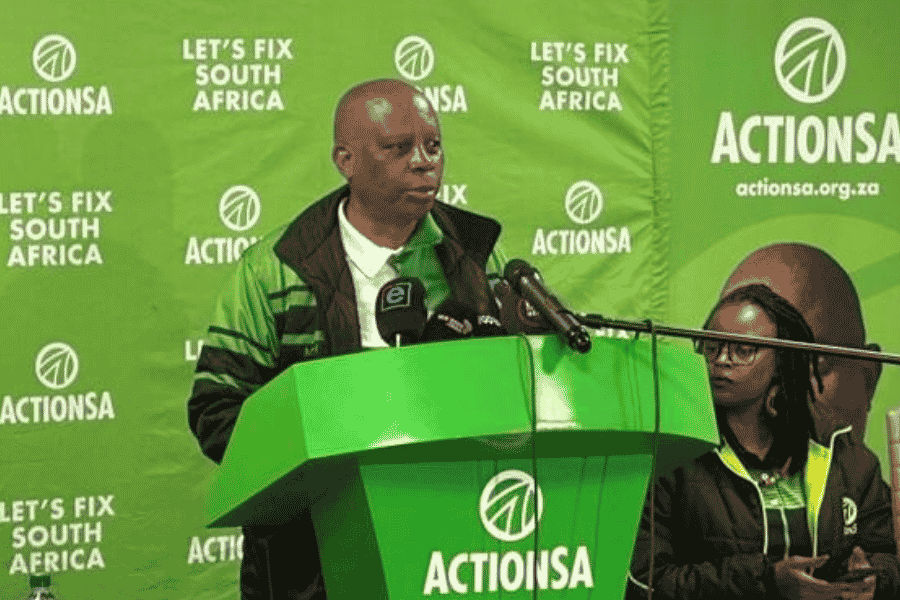
The DA’s urgent Electoral Court application against ActionSA, the EFF, MK Party and GOOD — in which it accuses the four opposition parties of hiding their PR candidates from voters — has sparked a furious backlash.
The DA filed papers on Tuesday challenging the submission of PR lists containing only one name — a tactic the DA says is a deliberate attempt to mislead voters ahead of the 2026 Local Government Elections.
In a statement, DA Federal Council Chairperson Ashor Sarupen said the parties were bending the law.
“The DA has filed an urgent application in the Electoral Court against ActionSA, the EFF, the MK Party and GOOD, for their attempt to bend the laws governing candidate lists in this year’s Local Government Election,” Sarupen said.
“The DA’s papers challenge the deliberate submission of proportional representation lists with only one name on them… a decision we view as deliberately concealing their candidates from voters.”
At the centre of the dispute is a provision in the Municipal Electoral Act which allows the Electoral Commission to notify a party if its PR list contains fewer candidates than seats won and request a supplemented list within two days.
“ActionSA has nominated more than 2,000 individual ward candidates while submitting one-person PR lists in virtually every municipality it contests. In Johannesburg, where it currently has dozens of PR councilors, it has submitted just one PR candidate,” Sarupen said.
The party said MK and GOOD had followed the same pattern.
But GOOD says it will oppose the case and has defended its strategy as lawful and transparent.
“GOOD will file its response to the DA’s court case with the Electoral Court. In essence, GOOD is not concealing our candidates, nor perverting the election of candidates, because all of our ward councillor candidates are also potential PR councillors. We do not have a separate or secret pool of candidates,” GOOD secretary-general Brett Herron said.
“Our ward councillor candidates are named and publicly available and our PR lists will be drawn from that publicly named pool of candidates.”
Herron said it uses the lawful provision to supplement lists after the election to assess candidates during the campaign.
“It allows us to more fully assess candidates during the campaign and not just based on a secretive and private interview with a selection panel. The robustness of a campaign allows both the party, and the voters, to assess the capacity of candidates to do the work of a servant councillor far better than an interview or theoretical assessment,” he said.
“Secondly, we anticipate the strong likelihood that there will be coalition governments everywhere we are contesting including Cape Town. Supplementing the lists allows us to respond, more flexibly and appropriately, to the skills and experience needs of any coalition government we form part of.”
ActionSA launched its sharpest attack yet on the DA, calling the case a desperate and hypocritical stunt to disenfranchise voters.
“The latest stunt by the DA to challenge the PR lists of ActionSA, along with those of other parties, is a desperate attempt by the DA to disenfranchise voters they simply cannot win in South Africa,” ActionSA said in a statement on Wednesday.
“The provision that the DA challenges in the Municipal Electoral Act makes provision for parties to legally supplement their lists without any limitation on how they elect to do so. It is a practice that has been followed by many political parties over multiple Local Government Elections, including by the DA itself.”
The party said its candidate selection policy, which is publicly available, ensures its PR list is supplemented after the election by ward candidates in descending order of performance.
“This was designed so that it is the South African people who determine the order of our PR list based on the merit of our ward candidates, their vision for service delivery, and the effectiveness of their campaigns. When compared to the smoke-filled rooms of the DA’s Federal Executive or ANC NEC, this is by far the most transparent and democratic way of populating a PR list,” ActionSA added.
It accused the DA of never challenging the law when it suited the party, despite holding the Home Affairs portfolio in the Government of National Unity.
“The DA’s legal case must be treated with cynicism, given that they have never challenged this in any election in which this legal provision has been utilised by many parties, including their own. Not only has the DA never sought to amend this legislation in the many years they have served in Parliament, but also, over the last two years, where they have been part of a majority GNU government and held the Ministry of Home Affairs, which is the portfolio from which all electoral legislation emanates, no steps have been taken to amend this legislation,” the party said.
ActionSA further claimed the DA itself has submitted one-seat lists in 12 municipalities in the 2026 elections, including Ntabankulu, Umzumbe, Mkhambathini, Nqutu, Msinga, uMvoti, eDumbe, Nongoma, Ulundi, Big Five Hlabisa, Mfolozi and Maphumulo.
“It is unclear how it is that the DA intends to take political parties to court over a practice that they have not only used in prior elections themselves, but that they intend to use in this election as well,” ActionSA said.
The party quoted the Municipal Electoral Act: “If a party list contains fewer candidates than the party is entitled to, the Electoral Commission must in writing immediately notify the party of the exact shortfall and request the party to deliver within two days of the notice a list supplemented by the name or names of one or more eligible candidates.”
“The essence of the Democratic Alliance’s court case is to read things into these provisions of the Municipal Electoral Act that the legislators simply did not include,” ActionSA said.
ActionSA said it will ask the court to punish the DA for abuse of process.
“ActionSA is prepared to meet this disgusting legal action head-on and will ask the courts to punish the DA for this flagrant abuse of the court’s time at a time in which everyone’s energy should be focused on ensuring free and fair elections in which no South African is disenfranchised,” it said.