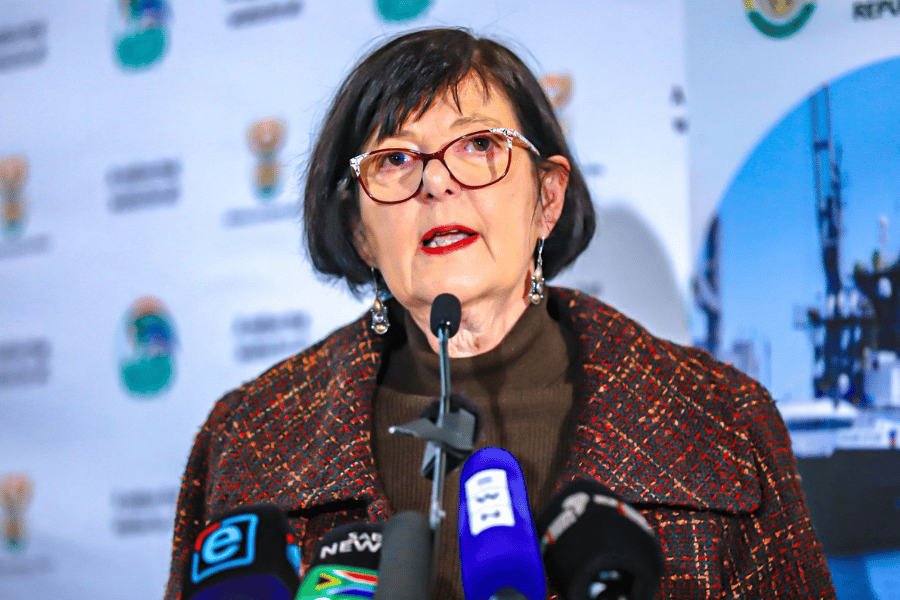
Transport Minister Barbara Creecy has challenged the taxi industry to put more women in the driver’s seat of the multibillion-rand sector, saying they should not remain mere passengers but become owners, fleet managers, mechanics and executives.
Creecy was speaking at the SANTACO Summit on Women’s Safety and Empowerment in Transport on Monday, where she also called for stronger measures to protect women and children from gender-based violence and femicide at taxi ranks and inside minibus taxis.
“Women should not just be passengers in the taxi industry; they must be owners, fleet managers, mechanics, and top-tier executives,” Creecy said.
“True transformation means moving women from the back seat to the steering wheel of economic power.”
The minister said women remain severely underrepresented in the minibus taxi industry, with International Labour Organisation figures showing that they account for only about 2% of the sector’s workforce and own just 2.8% of operational minibus taxis.
She said most women working in taxi associations remain concentrated in entry-level positions such as administrative clerks, fare collectors and rank kitchen staff.
Creecy said this needed to change, arguing that women should be given opportunities to lead regional taxi associations, own fleets, manage fuel depots, run scholar transport and participate in manufacturing and supply contracts.
The taxi industry transports about eight million commuters daily and is one of the largest black-owned sectors in South Africa, with annual revenue estimated at between R60 billion and R100 billion, according to Creecy.
She said government was working with SANTACO on reforms aimed at creating a safer, more efficient and better-regulated public transport system.
The reforms include repurposing the current taxi recapitalisation grant to help operators buy cheaper vehicles with lower repayments, speeding up the development of an online licensing system and establishing nine pilot Transport Operating Companies.
Government also plans to reform the current public transport grant system by moving towards a unified public transport support model.
Creecy urged SANTACO Women to ensure they were properly briefed about the reforms and actively participated in the process.
She said many women enter the taxi industry after inheriting a route or permit from a deceased husband or parent, often without formal preparation or having chosen the industry themselves.
“Training, mentorship and access to finance need to be at the core of SANTACO Women’s efforts to ensure smooth transition and provide direct support in such instances,” Creecy said.
The minister also warned that the taxi industry had a major responsibility in the fight against GBVF because of its deep reach into communities.
“Taxi ranks, routes and vehicles are daily points of contact with women, children, learners, workers, traders and vulnerable persons,” she said.
“This gives the industry both reach and responsibility in the national effort to end Gender Based Violence and Femicide.”
Creecy commended SANTACO Women and civil society groups for initiatives such as the Safe Minibus Taxi Charter and anti-GBV training, but warned that training alone was not enough.
“Training is only the first gear. We need active enforcement and zero tolerance for abuse at every rank and on every route,” she said.
She called for taxi ranks and roads to become safe zones, with drivers, operators and marshals acting as the first line of defence against harassment and abuse.
“Our roads and taxi ranks must be turned into safe zones,” Creecy said.
“If you see harassment, you must speak up.”
Creecy said government would continue working with SANTACO to implement the National Strategic Plan on Gender-Based Violence and Femicide 2020–2030.
She also challenged SANTACO to set measurable targets for increasing women’s participation in the industry.
“I challenge SANTACO today to set bold, measurable targets to ensure the taxi industry an inclusive enterprise that the next generation of women will be proud to inherit,” she said.