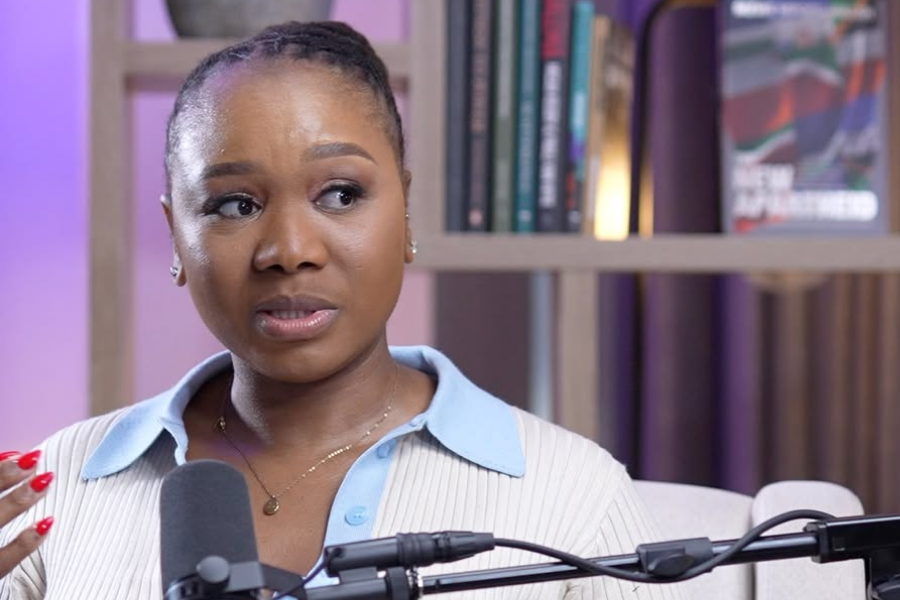
Bestselling author Jackie Phamotse believes the role of women in South Africa’s alleged corruption and criminal networks is being underestimated, arguing that some women around powerful men may be far more influential than their public image suggests.
Speaking on the SMWX podcast, Phamotse said women are often seen as ‘slay queens’ or portrayed as naïve partners who simply benefit from the wealth and lifestyles of powerful men.
She believes that portrayal can obscure the ways in which relationships, social connections and business networks can operate around powerful figures.
“We underestimate the role that these women play. We see them as fragile and innocent and say, ‘Oh, they’re just pretty girls, it’s okay, they didn’t do anything. They were just there for the money.’ No, they were not’,” she said.
Phamotse said some women who operate within these circles have education, business experience, negotiating skills and access to influential social networks.
“Some of these girls are educated and they have strong negotiating skills. Some of them come from families who have been in business in and around South Africa for a long, long time,” she continued.
She said social connections built through universities, families, business and leisure activities can become important avenues of access.
“They know each other because they went to varsity together and so forth,” she said.
Phamotse argued that men who rise into wealthy circles from less privileged backgrounds may deliberately seek relationships with women who already have access to influential social and political networks.
“So guys like Cat Matlala and Thabo Bester, who essentially come from nothing, they would want to date a girl who went to Wits, whose parents are this, that and that, so that they get into certain political spaces and elite groups, and they socialize differently,” she explained.
She said women could become bridges into networks that would otherwise be difficult for outsiders to penetrate, and argued that shared social interests, such as cars and horses, could also create opportunities for relationships between wealthy individuals and people seeking access to particular circles.
The role of women is also central to The Big Five Cartel, Phamotse said, particularly through the fictional character Imani, whom she described as an educated woman who owns a business but becomes emotionally involved with the fictional cartel kingpin.
According to Phamotse, Imani’s vulnerability is not a lack of intelligence, but her desire for affection and recognition.
“She is educated. She owns a business. But her desire to be seen, to be wanted, to be appreciated really is her demise at the end of the day,” she said.
Phamotse said she deliberately moved away from the familiar depiction of women in South African fiction as victims emerging from poverty.
“A lot of people complain about South African authors always writing stories from a poverty landscape or point of view where all the females are abused and they come from a very poverty-stricken background. I really wanted to move away from that, to show that even the smart girls with all the education, with a good family background, will fall into the hands of the wrong people,” she explained.
She argued that education, wealth and social standing do not necessarily protect someone from becoming entangled in damaging relationships.
Phamotse also drew a distinction between being a passive romantic partner and actively helping shape a powerful man’s public and business image, using the wife of alleged crime figure Vusimuzi “Cat” Matlala, Tsakani Matlala, as an example.
“She’s not a regular slay queen. She’s a girl who masterminded how to make his business look presentable. She’s the networker, she’s the fixer. She made him look desirable in business. She’s the stylist. She’s the girl who makes sure that he is presentable to the world,” Phamotse said.
She went further, alleging that Matlala’s wife was instrumental in handling aspects of his business and negotiations, and argued that the public may focus on the man at the centre of a controversy while overlooking the people who help create and maintain the image around him.
Phamotse said her broader point was that women should not automatically be viewed as powerless figures simply because they are romantically linked to powerful men.
“She’s smart. She’s exceptionally smart. We might underestimate the women and think, ‘Oh, these are just slay queens. These are just girls.’ Some of those girls have dangerous minds,” she said.
She described the potential transactional nature of relationships within powerful circles, suggesting that social and romantic connections could be used to facilitate access to influential people.
“It’s easy to auction a girl like that, in a sense to say, ‘You are my wife, but if you sleep with the minister so-and-so, I’ll get the deal. If you go to dinner with so-and-so, I’ll get that. If you befriend so-and-so’s wife, I’ll get closer to that circle group.’ So the girl is the key,” she said.
Phamotse’s contention is that the networks around such figures, including business associates, friends, romantic partners and social connections may also warrant scrutiny.