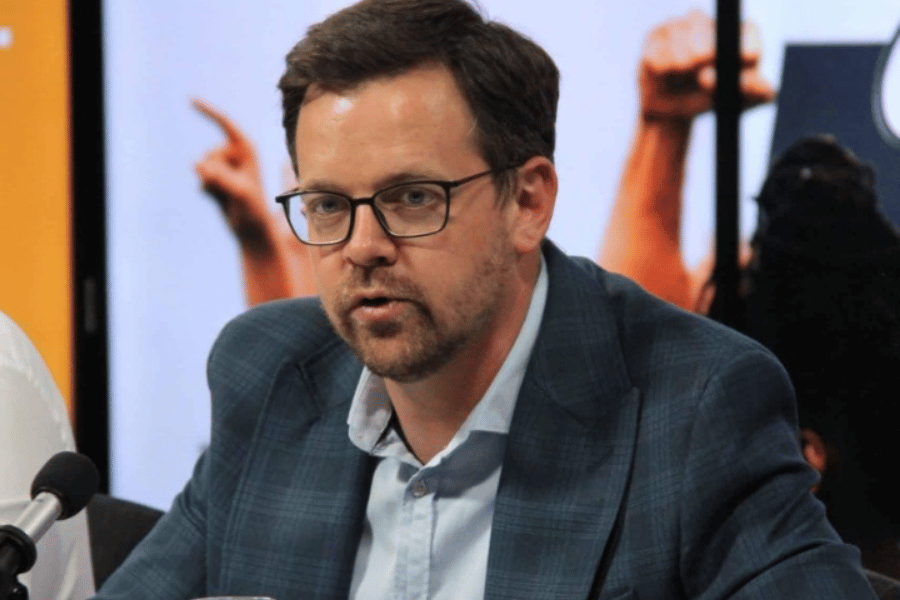
Afrikaner activist Ernst Roets says he will take what he describes as South Africa’s ‘worsening farm attacks’, threats to property rights and racial legislation to Washington DC, accusing President Cyril Ramaphosa of repeatedly denying realities facing minority communities.
Roets said his organisation Lex Libertas would travel to the United States in September, where it plans to erect 3 000 white crosses on the National Mall bearing the names of people it says were murdered during farm attacks in South Africa.
While farm attacks and murders are a documented crime phenomenon in South Africa, claims that white farmers are being systematically targeted as part of a “white genocide” have not been substantiated by credible evidence.
Police statistics record crime on farms and smallholdings, but do not establish the existence of a coordinated campaign to eradicate white farmers.
However, in a video message directed at Ramaphosa, Roets accused the president of being either dishonest or ignorant about the scale of farm attacks in the country, referring to comments Ramaphosa made in New York in 2018.
“You might recall that when you spoke in New York City in 2018, you said, and I quote, There are no killings of farmers or white farmers in South Africa,” Roets said.
“You added that there are no land grabs and that there is no threat to property rights.”
Roets said he believed those comments could only be explained in one of two ways.
“It’s either a blatant lie or a case of severe ignorance about the state of affairs in South Africa, because farm attacks are indeed a harsh reality and there is indeed a threat to property rights,” he said.
Roets also referred to previous parliamentary discussions about farm murders, arguing that this made it difficult to accept that the government did not recognise the phenomenon.
The planned Washington campaign, he said, would involve victims and experts speaking about farm attacks, race-related laws, property rights and what he described as incitement of violence against minorities.
“We’re going to publish extensive research about what is happening in South Africa, because in our analysis, South Africa does not suffer as a result of only one crisis, but a conglomeration of crises,” Roets said.
“These crises, as far as we are concerned, are symptoms of one deeper rooted crisis, an unsustainable political system that has become too centralised and as a result, detached from basic realities, but impervious to transparency and accountability.”
Roets said the purpose of taking the campaign abroad was to draw international attention to what he described as a crisis in South Africa and to pressure policymakers and others to engage with the issues.
He said the initiative was partly a response to what he regarded as repeated government denials.
“To be frank, Mr. President, it would not have been necessary for us to do any of this if you, the ANC and the government of national unity were open and honest about the state of affairs in South Africa,” he said.
“So in a sense you can think of our endeavour as a form of damage control, responding to the damage that has been done by repeated public denial of basic realities in this country.”
Roets said the group would ask the US government, policymakers, journalists and members of the public to contribute to addressing the issues it intends to raise.
However, he insisted that the organisation would prefer South Africa’s problems to be resolved domestically.
“We would much rather resolve the problems of South Africa in South Africa,” he said.
Roets acknowledged Ramaphosa’s repeated calls for South Africans to resolve domestic matters within the country, but argued that this required government to make itself accessible to groups seeking to raise fundamental concerns.
He said his organisation had written to Ramaphosa in January seeking discussions about what it described as South Africa’s growing governance crisis, deteriorating relations between communities and the state, constitutional reform, decentralisation, self-governance and the country’s increasingly strained relationships with international partners.
“Our position was and remains that the problems facing South Africa are deeper than disagreements about policy,” Roets said.
“And that is why we need to talk.”
He accused the president, Cabinet, Parliament and, in some respects, the courts of being inaccessible to those seeking to challenge what he described as the underlying political order.
Roets also criticised the government’s recently announced national dialogue, questioning whether it constituted genuine engagement.
He referred to estimates that the dialogue was initially expected to cost R740 million before later figures placed the cost at R441 million.
“Now dialogue is important, but the national dialogue was not much more than window dressing,” he said.
“Not only did nothing change, more importantly, it was not much more than a conversation among people who already accept the basic ideological premises of the current political project, while merely disagreeing about how to effectively implement this project.”
Roets said a genuine national dialogue should include people who challenge the premises of the existing political system rather than only those who agree with its fundamentals.
“A genuine dialogue must include those who question the premises,” he said.
“And so Mr. President, you need to understand that when people cannot be heard in Pretoria, they will eventually be heard somewhere else.”
Roets said the planned White Cross project was not intended to provoke conflict with the South African government.
“The White Cross project does not exist simply to explain what is happening in South Africa,” he said.
“We are not seeking conflict with the South African government, and we’re not there to complain.”
“We are seeking solutions, peaceful and constitutional solutions.”
He nevertheless challenged Ramaphosa to engage directly with those raising the concerns.
“You still have the opportunity to meet with those who are raising these concerns,” Roets said.
“You can still listen to the families affected by farm murders.”
“You can still listen to communities that experience racial legislation, not just as some abstract policy debate, but as a form of exclusion.”
“You can still listen to valid concerns about the future of property rights in South Africa.”
“You can still sit down and speak with those who are arguing for decentralisation and self governance.”
Roets said the group did not expect the president or government to adopt its political views, but argued that disagreement should not prevent dialogue.
“You do not have to agree with us, but you cannot have your cake and eat it,” he said.
“You cannot simultaneously tell the world that South Africa’s problems should be resolved within South Africa while refusing meaningful access to those who are trying to discuss precisely those problems with you.”
Roets said the Washington campaign would go ahead if meaningful engagement did not take place in South Africa.
“In September we will take our message to Washington,” he said.
“We will tell the American public and international audiences what is happening in South Africa.”
“We will display the names of the victims of the very crime phenomenon that you claim does not exist.”
“We will present evidence and we will argue for solutions, but that is just the beginning.”
Crime, however, is a national problem affecting South Africans across racial and geographic lines.
SAPS crime statistics record widespread murders, robberies and other violent offences across communities throughout the country.
Roets said his organisation remained open to discussions with the president but would not wait indefinitely for an opportunity to engage.
“If these matters can be addressed constructively here in South Africa, they should be,” he said.
“But if they cannot be addressed and the doors remain closed, you should not be surprised when we take our message to the rest of the world.”